
“Family physicians see the whole picture.”
A seminar titled “Fundamentals of Family Medicine: Definitions and the WONCA Tree,” organized under the auspices of Academic Solidarity, addressed the core aspects of the field. Held on August 31, 2026, the seminar was presented by Prof. Dr. Zekeriya Aktürk. The session covered a broad scope, ranging from the historical evolution of family medicine to its current definition, and from the core competencies established by WONCA Europe to the central role family medicine plays within the healthcare system.
One of the presentation’s notable starting points was the observation that, unlike many other medical disciplines, family medicine constantly feels the need to define itself and its place within the healthcare system. A key reason for this is that family medicine is a generalist discipline defined not by a specific organ, disease, or technical procedure, but rather by the individual’s overall health issues, living conditions, and relationship with the healthcare system. Indeed, according to WONCA Europe’s 2023 definition, family medicine is an academic and scientific discipline with its own unique educational content, research scope, evidence base, and clinical practice; it is also a clinical specialty focused on primary care.
The seminar highlighted that the intellectual roots of family medicine extend much further back than modern medicine. In the 5th century BC, Hippocrates and the School of Kos prioritized the sick person—along with the disease’s progression over time and its prognosis—over the disease itself. In contrast, the School of Cnidus (modern-day Datça), active during the same period, placed greater emphasis on classifying diseases according to their symptoms and the organ systems affected.
These two approaches can be viewed as historical precursors to the generalist-versus-organ-based distinction found in medicine today:
Kos: “Who is the patient, and how is the disease progressing?”
Knidos: “What illness does this person have?”
For this reason, Kos and the Knidos/Datça region—located at the borders of modern-day Turkey—hold special significance not only for the history of ancient medicine but also as a symbolic geography representing two distinct modes of medical thought.
Family medicine has experienced ups and downs throughout history. While the trend toward specialization—which accelerated particularly in the first half of the 20th century—temporarily overshadowed the importance of general practice, the fragmentation of healthcare systems and coordination issues arising from the 1960s onwards clearly demonstrated a renewed need for family medicine. The presentation highlighted the Millis, Willard, and Folsom reports of 1966 as key milestones in this restructuring process.
A noteworthy historical example from Turkey was also highlighted: Law No. 224 on the Socialization of Health Services. Spearheaded by Prof. Dr. Nusret Fişek and his colleagues—despite his role as Undersecretary of the Ministry of Health during a coup era—this legislation introduced a highly progressive vision as early as 1961. It integrated principles such as population-based care, regional responsibility, the unification of preventive and curative services, teamwork, continuity of care, and referral mechanisms when necessary.
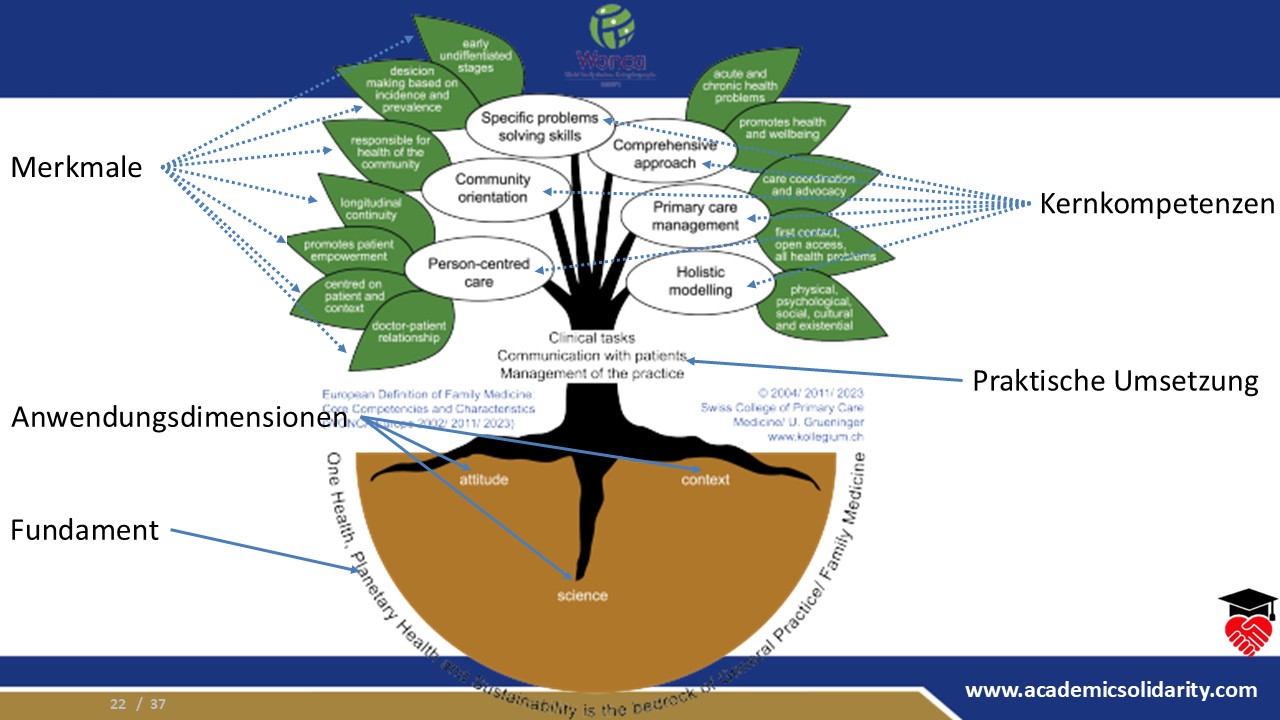
The scope of modern family medicine was evaluated using the WONCA Tree model. In this context, the fundamental characteristics of family medicine as reflected in daily practice were also discussed in detail:
- Addressing health and illness in a multidimensional manner
- Serving as the initial point of medical contact within the health system
- Coordinating health services and acting as a patient advocate when necessary
- Promoting health and well-being
- Managing acute and chronic issues concurrently in the same individual
- Addressing undifferentiated illnesses and conditions in their early stages
- Employing a unique decision-making process that takes into account prevalence and incidence at the primary care level
- Bearing responsibility for community and environmental health alongside individual health
- Developing a special physician-patient relationship through repeated encounters
- Ensuring longitudinal continuity of care
- Empowering the patient in the management of their own health
- Adopting a person-centered approach that focuses on the individual—within the context of their family and environment—rather than on the disease itself.
(Wonca-Europe 2023; https://www.woncaeurope.org/resources/view/the-european-definition-of-general-practice-family-medicine-wonca-europe-2023-edition)
These characteristics demonstrate that family medicine is not merely “knowing a little bit about everything”; rather, it is a distinct medical specialty with its own unique methods of clinical reasoning.
Continuity and coordination were also among the key topics emphasized during the seminar. In countries where family medicine is at the heart of the healthcare system, the family physician’s responsibility does not end with referring a patient to another specialist. As early as the 1966 Millis Report, it was stated that the primary care physician’s responsibility toward the patient continues even after a referral has been made.
Germany serves as a current example of this model. A family physician is responsible not only for the patient’s immediate illness but also for the continuity of their overall health. Once a patient is referred to a specialist, the family physician expects to receive feedback following the specialist’s assessment. Furthermore, the purpose of a referral is not merely to “hand over” the patient; the family physician can define the scope of the consultation, requesting either a general opinion or an answer to a specific question from the other specialist. The findings are then consolidated by the family physician to formulate a holistic treatment plan for the patient. WONCA’s concept of coordination also reflects this function.
One of the seminar’s key messages was that ensuring family physicians are well-trained—both theoretically and practically—is essential for the effective functioning of the healthcare system.
Family medicine is not an alternative to other medical specialties; it is a medical specialty on par with them. Consequently, the quality, scope, and duration of residency training in family medicine must match those of other specialties. This is because having physicians who lack adequate clinical competence at the healthcare system’s entry point creates quality issues not only in primary care but can also overwhelm the entire system through unnecessary referrals, diagnostic tests, and hospital visits.
At the conclusion of the seminar, the study titled “Hausärztliche Primärversorgung – Garant für unser Gesundheitssystem” (General Practice Primary Care – A Guarantee for Our Healthcare System), published by the German Society of General Practice and Family Medicine (DEGAM) in 2026, was discussed. DEGAM regards family medicine as a fundamental guarantee of a cost-effective healthcare system (DEGAM 2026 https://link.springer.com/article/10.1007/s44266-026-00563-6).
The key message emerging from the seminar can be summarized as follows: Organ-specific specialties are indispensable elements of medicine; however, it is the family physician who views the patient’s entire journey within the healthcare system, integrates diverse information, preserves health before disease manifests, makes decisions amidst uncertainty, and engages other specialties when necessary. “Family physicians see the whole picture.”