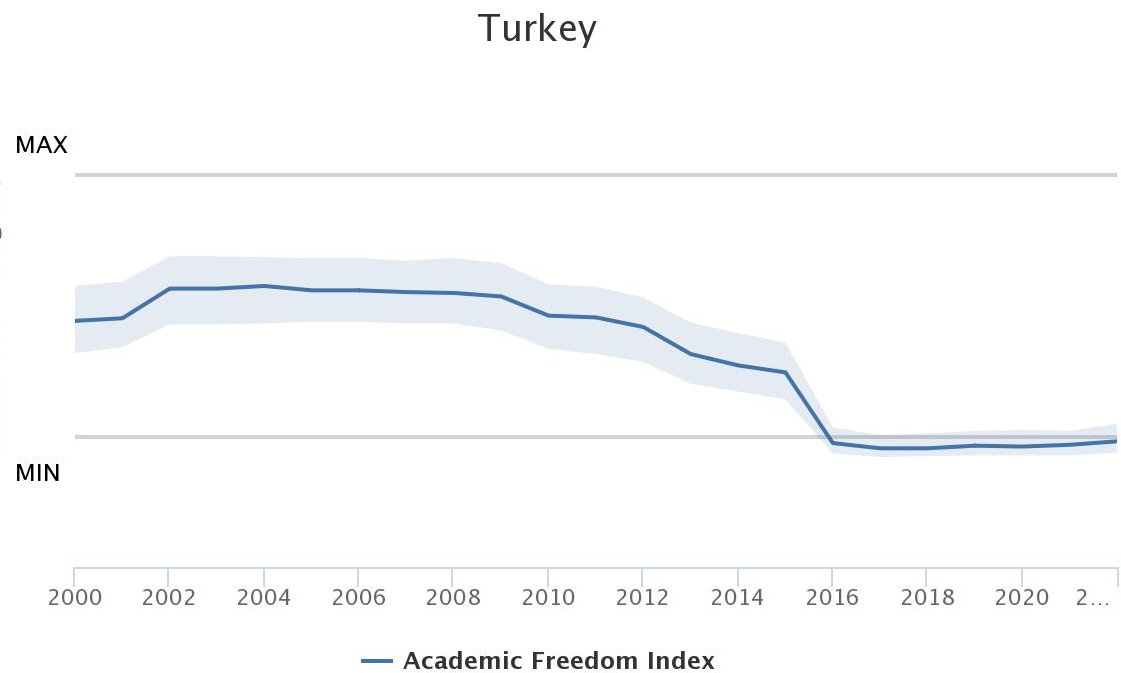


With a score of 0.09 on the Academic Freedom Index, Türkiye is among the countries where academic freedom is “completely restricted.”
Academic freedom is sometimes perceived as merely an internal matter for universities. However, the subjects academics can research, the findings they can publish, the ideas students can debate, and the extent to which universities can independently select their administrators are among the most significant indicators of freedom of thought and expression in a society.
There are numerous organizations worldwide that monitor academic freedom and support academics facing threats. One of the most prominent among them is Scholars at Risk (SAR).
SAR (https://www.scholarsatrisk.org/) is an international network comprising more than 650 higher education institutions, organizations, and supporters in more than 50 countries. SAR’s work can be broadly categorized into three areas: providing safe working opportunities for academics under threat, monitoring and publicizing violations of academic freedom, and developing national and international policies to safeguard academic freedom.
There are other organizations active in this field as well. The Council for At-Risk Academics (Cara) (https://www.cara.ngo/)—established in 1933 to assist academics forced out of Nazi Germany—continues to help academics facing threats to pursue their work in other countries. The Institute of International Education – Scholar Rescue Fund (IIE-SRF) (https://www.scholarrescuefund.org/) provides academics who are under threat or displaced with temporary, funded academic positions at universities worldwide. Meanwhile, the PAUSE program in France (https://www.programmepause.fr) supports scientists and artists in exile, enabling them to continue their work at French universities and research institutions.
When considered alongside similar programs—such as the Philipp Schwartz Initiative in Germany (https://www.humboldt-foundation.de/en/apply/sponsorship-programmes/philipp-schwartz-initiative)—we can identify three complementary areas of activity: measuring and monitoring academic freedom, documenting violations, and protecting scholars at risk.
An important tool complementing the work of these organizations is the Academic Freedom Index (AFI) (https://academic-freedom-index.net/). Conducted by Friedrich-Alexander-Universität Erlangen-Nürnberg and the V-Dem Institute, the AFI assesses the actual state of academic freedom across 179 countries and territories based on five key dimensions: freedom to research and teach, freedom of academic exchange and dissemination of findings, institutional autonomy, campus integrity, and freedom of academic and cultural expression. The 2026 assessment relies on evaluations by 2,357 country experts and V-Dem’s statistical model.
Scholars at Risk recently published its report. This marks the twelfth annual report released by SAR as part of its Academic Freedom Monitoring Project.
The report examines the period from July 1, 2025, to June 30, 2026, documenting 382 attacks against scholars, students, and higher education institutions across 59 countries and territories. SAR specifically addresses developments in 22 of these countries in detail. The concept of “attack” here should not be understood solely as physical violence. According to the SAR definition, this category encompasses—in addition to killing and physical violence—arrests, imprisonment, travel restrictions, the loss of academic positions, the closure or obstruction of university operations, and pressures or threats that undermine university autonomy.
According to the report, threats to academic freedom worldwide are unfolding in two main ways. The first is the more visible form of direct repression: the arrest, prosecution, disappearance, or subjection to violence of academics or students, and the suppression of student protests through the use of police or military force.
The second, less visible mechanism involves state interference in university autonomy. Key issues highlighted in the report include governments exerting control over curricula, restricting certain research topics, allocating funds on political or ideological grounds, appointing political figures to university administrations, and curtailing academic institutions’ authority to select their own leaders, faculty members, and research agendas.
Using the latest data from the Academic Freedom Index (AFI), *Free to Think 2026* also assesses the situation in 22 countries and regions highlighted in the report. According to the AFI, nine of these fall into the “completely restricted” category—the lowest tier regarding academic freedom: Afghanistan, China, the occupied Palestinian territories (Gaza), Iran, Russia, Turkey, Syria, Venezuela, and Zimbabwe.
The report lists Türkiye’s 2025 AFI score as 0.09, noting that the country ranks within the bottom 10 percent of nations globally.
The report specifically criticizes the regulation adopted on July 1, 2025, which granted the President the authority to appoint rectors for both state and foundation universities. SAR views this development as a move that limits the academic community’s ability to determine university leadership.
Boğaziçi University is also highlighted in the report. It notes that protests by faculty members in defense of university autonomy—sparked by the 2021 rector appointment controversy—are continuing into their fifth year. Detentions during student demonstrations and judicial measures imposed on certain protesters are cited as examples within the report.
The report also addresses the case of academic Emrah Gülsunar, who spent 36 days in prison over a social media discussion about political regimes, framing the incident in the context of academic and political freedom of expression.
According to SAR, restrictions on university autonomy and the shrinking space for academics and students to express dissenting views are key factors contributing to Türkiye’s placement in the lowest AFI category for academic freedom.
The report cites the long-standing protests by Boğaziçi University faculty members as an example of how academic communities can continue to defend institutional autonomy. On the other hand, according to the Academic Freedom Index 2026, academic freedom declined statistically in 50 of the 179 countries and territories examined over the past decade, while improvements were observed in only 9.
Free to Think 2026 also emphasizes that repression is not limited to authoritarian regimes. The report discusses various forms of political interference regarding curricula, research funding, university governance, and academic expression in the US, India, Serbia, and other countries. Consequently, one of SAR’s key messages is that the issue of academic freedom cannot be reduced to a specific geography or form of government.
Key responsibilities for states include explicitly recognizing and defending academic freedom; establishing support mechanisms for scholars and students at risk; and investigating attacks on academic communities while holding perpetrators accountable. SAR also calls on states to respect university autonomy and to refrain from militarizing universities, engaging in surveillance, exerting financial pressure, interfering in the selection of academic staff and students, and dictating the content of research or teaching. Recommendations also include reviewing laws that penalize scholars and students for their views.
Universities, meanwhile, are tasked with actively defending institutional autonomy. The call demands that academic and administrative decisions be based on academic criteria rather than political or financial pressure; that the freedom of expression of academics and students be protected; that fair procedures be guaranteed in disciplinary processes; and that campuses be preserved as spaces—both physical and digital—where ideas can be debated without fear. Furthermore, it is proposed that universities provide temporary, safe academic positions for at-risk scholars through programs such as SAR, Cara, IIE-SRF, PAUSE, and the Philipp Schwartz Initiative.
The call directed at civil society and the public urges strengthening solidarity networks, sharing information about violations, supporting regional academic freedom coalitions, and preventing the isolation of scholars at risk.
Academic freedom is not merely about how academics practice their profession. The ability of universities to ask questions, debate established assumptions, and critically examine all forms of power—including political authority—is a fundamental function of science and higher education.
Therefore, the fact that Türkiye currently ranks alongside countries such as Afghanistan, China, Gaza, Iran, Russia, Syria, Venezuela, and Zimbabwe in the category of nations where academic freedom is “completely restricted” warrants reflection not only by universities but by society as a whole.