

Even those who claim to oppose authoritarianism can themselves become authoritarian! Institutions that cannot tolerate criticism, silence dissenting voices, and leave decision-making in the hands of a select few contradict the very values they profess to uphold. Therefore, the struggle against authoritarianism must begin within our own ranks.
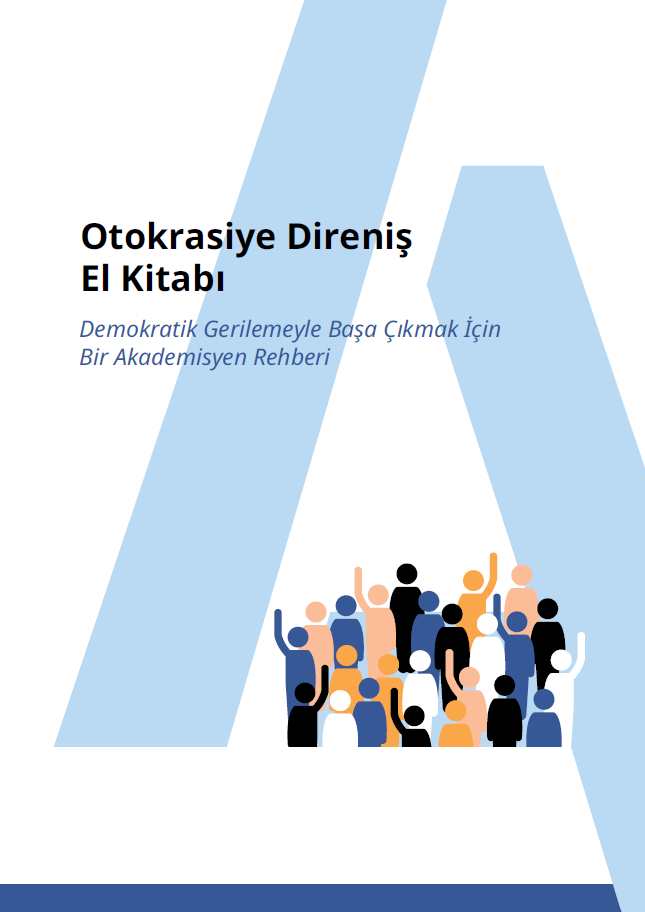
At a time when democratic institutions are weakening, academic freedoms are under threat, and authoritarian tendencies are gaining ground across the globe, “The Anti-Autocracy Handbook: A Scholars’ Guide to Navigating Democratic Backsliding” (https://zenodo.org/records/15696097) has been made available in Turkish.
Developed through the joint efforts of researchers from prestigious institutions worldwide, including the University of Bristol, the University of Potsdam, the Max Planck Institute, the University of Queensland, University College London, and Cornell University, the work was first published in English on June 19, 2025. It has since been translated into five languages, with further translations currently underway.
The Turkish translation of the handbook was undertaken by Academic Solidarity e. V. and released as an open-access resource on October 26, 2026 (https://doi.org/10.5281/zenodo.23526712).
The Handbook examines, in light of scientific research, how democratic backsliding begins, the methods employed by authoritarian regimes, and how individuals and institutions can respond to these developments.
The work specifically highlights three primary mechanisms of authoritarianization: populism, polarization, and “post-truth” discourse. Through these methods, it becomes possible to divide societies, weaken the shared perception of reality, and render democratic institutions ineffective.
The booklet does more than just identify problems; it offers concrete suggestions on assessing individual risks, ensuring digital security, defending scientific facts, building networks of solidarity, and navigating various paths in the face of oppression.
Although originally prepared for academics, the Handbook can be a valuable resource for teachers, journalists, civil society workers, students, and anyone who values democratic principles.
Perhaps the most thought-provoking aspect of the booklet is its reminder that the drift toward authoritarianism is not a problem exclusive to state governments.
Authoritarian tendencies can also emerge within civil society organizations, academic institutions, professional associations, and even groups established specifically to defend democracy and human rights.
Behaviors such as intolerance toward dissenting views, perceiving criticism as a personal attack, concentrating decision-making power within a narrow circle, excluding opposing voices, and shielding leaders from accountability can erode democratic culture even in small-scale organizations.
Therefore, defending democratic values should not merely mean opposing others’ authoritarian practices; it also requires a critical examination of our own behavior, relationships, and how our institutions function.
Being open to criticism, ensuring that diverse perspectives can be expressed, maintaining transparency in decision-making processes, and safeguarding pluralism are among the most vital institutional habits that can be cultivated to counter authoritarianism. As Academic Solidarity, we do not view the translation of this booklet into Turkish merely as a translation project. Our goal is to ensure that the scientific knowledge and recommendations presented in the work reach a broader audience.
To this end, we plan to organize online seminars and discussion forums with the authors’ participation, introduce the work to academic and civil society circles, and explore how its recommendations can be applied in daily life and institutional practices.
We intend for these efforts not only to strengthen solidarity against authoritarian regimes but also to foster a more democratic, participatory, and open-to-criticism culture within our own organizations.
The most enduring defense against authoritarianism is not merely to articulate democratic principles, but to put them into practice in our daily lives.
We invite you to read and share this booklet, and to join us in reflecting on the recommendations it contains.