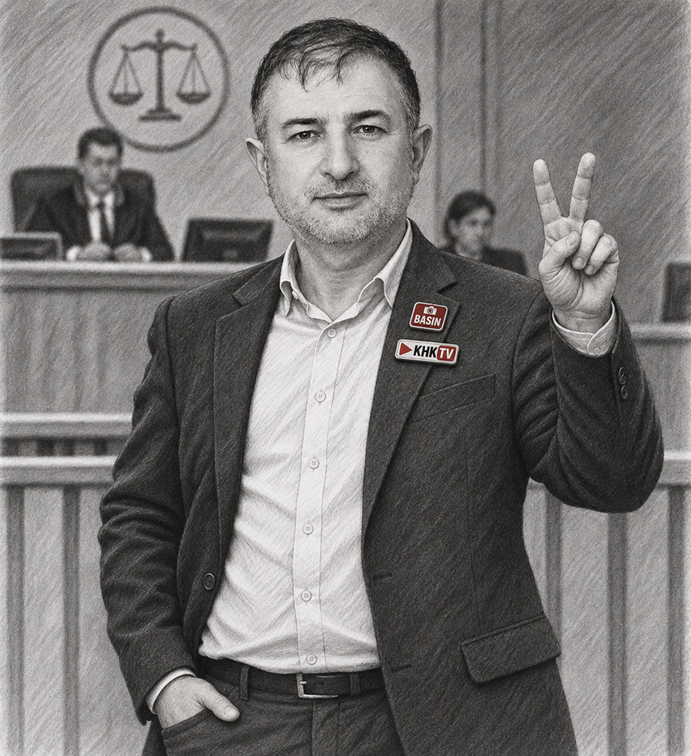


In Turkey, KHKTV reporter Ahmet Erkan Yiğitsözlü has been arrested. In a country where journalists, academics, and ordinary citizens must first weigh the potential consequences before deciding what to write, what to say, or what to share on social media, one cannot speak of freedom.
Freedom of the press is not merely a professional privilege for journalists; it is a fundamental human right for everyone. It is a prerequisite for society to learn the truth, for public power to be held accountable, for injustices to be brought to light, and for democratic mechanisms to function.
Indeed, Article 19 of the Universal Declaration of Human Rights guarantees not only the right to express one’s opinions but also the right to seek, receive, and impart information and ideas without any restrictions.
However, developments in Turkey (particularly over the last decade) demonstrate that this fundamental human right is being systematically violated.
Media silenced since July 15, 2016.
The state of emergency declared following the coup attempt on July 15, 2016, marked a significant turning point for press freedom in Turkey.
According to data from Reporters Without Borders (RSF) and the Media Ownership Monitor (MOM) project, 179 media outlets were shut down during the state of emergency. In the first two months of the state of emergency alone, 620 press cards and 34 parliamentary press cards were revoked (https://turkey.mom-rsf.org/tr/bulgular/el-koyulan-medya/).
| Type of organization | Number |
| Newspaper | 53 |
| Radio | 37 |
| Television | 34 |
| Publishing house and distribution company | 29 |
| Magazine | 20 |
| News agency | 6 |
| Total | 179 |
2016–2018 state of emergency period. Source: RSF – Media Ownership Monitor, İHOP.
It is, of course, the duty of the state to investigate a coup attempt and to ensure that those responsible are tried within the framework of the law. However, security concerns cannot justify the wholesale elimination of press freedom. Every newspaper, television channel, or publishing house that is shut down also signifies the closing of a window through which society can access information.
Türkiye in the world press freedom rankings
According to Reporters Without Borders’ 2026 World Press Freedom Index, Turkey ranks 163rd out of 180 countries (https://rsf.org/en/country-t%C3%BCrkiye). Furthermore, based on RSF’s assessment, approximately 90% of national media outlets in Turkey are under government control (https://bianet.org/haber/turkiye-de-medyayi-kimler-kontrol-ediyor-208089).
For journalists, the situation is even more concerning. According to reports by the Journalists’ Union of Turkey and other professional press organizations:
- Between April 2025 and April 2026, 67 individuals were taken into custody, and 19 journalists were arrested.
- In October 2026 alone, 20 journalists were taken into custody, and six of them were arrested.
- According to data from the Journalists Union of Turkey (TGS) dated November 13, 2026, 17 journalists and media workers are currently in prison.
- A report by the Dicle Fırat Journalists Association (DFG) dated November 3, 2026, states that the number of journalists in prison is 33.
https://www.tgs.org.tr/tgs-basin-ozgurlugu-raporu2025-2026/
https://www.expressioninterrupted.com/census.php
Merdan Yanardağ, Murat Ağırel, Mehmet Baransu, Ali Ünal, İsmail Arı, and Tuğba Tekerek are among the journalists currently in prison, despite coming from diverse ideological and media backgrounds (https://www.expressioninterrupted.com/census.php).

When it comes to defending press freedom, journalists’ political views should be irrelevant. We do not need to share a journalist’s worldview to defend their freedom.
Social media is no longer free either.
As pressures on traditional media have intensified, social media has emerged as an alternative space for expressing dissenting views and advocating for rights. However, in Turkey, this space is also increasingly shrinking.
According to data from the “EngelliWeb” (BlockedWeb) project—an initiative of the Freedom of Expression Association (İfade Özgürlüğü Derneği)—access-blocking orders were issued against more than 4,800 X (Twitter) accounts between 2015 and 2025 (https://ifade.org.tr/basin-bultenleri-ve-duyurular/engelliweb-2025/).
Even more striking is the fact that at least 2,137 X accounts were blocked in September and October 2026 alone (https://ifade.org.tr/basin-bultenleri-ve-duyurular/sansur-dalgasi-ekimde-de-surdu-iki-ayda-2-000i-askin-x-hesabi-erisime-engellendi/).
These access restrictions are not limited to individual accounts. In October 2026, following the appointment of state-appointed trustees (kayyım) to Halk TV, access-blocking orders were issued against the outlet’s YouTube channel—which had 2.59 million subscribers—as well as its X account (with 3 million followers) and its accounts on Facebook, Instagram, TikTok, and Telegram (https://tr.euronews.com/2026/10/14/halk-tvnin-sosyal-medya-hesaplarina-erisim-engeli-getirildi).
Amnesty International has characterized the operation against Halk TV as a severe infringement on freedom of expression and press freedom.
Censorship is no longer confined merely to preventing the printing of a newspaper. The digital memory that millions of people have accumulated over the years can be rendered inaccessible to the public through a few administrative or judicial decisions.
Cases involving insults to the President
One of the most striking indicators of the current state of freedom of expression in Turkey is the number of cases involving “insulting the President.”
According to data compiled from Ministry of Justice statistics, the number of individuals prosecuted on charges of insulting the President during the terms of Turkey’s last five presidents is as follows:
| President | Term of office | Number of defendants |
| Turgut Özal | 1989–1993 | 207 |
| Süleyman Demirel | 1993–2000 | 158 |
| Ahmet Necdet Sezer | 2000–2007 | 163 |
| Abdullah Gül | 2007–2014 | 848 |
| Recep Tayyip Erdoğan | 2014–2020* | 38.581 |
* The Erdoğan era, specifically the years 2014–2020. Source: A 2021 report compiled from Ministry of Justice statistics (https://www.hukukihaber.net/hangi-cumhurbaskani-icin-kac-dava-acildi).
Moreover, this practice continues to this day. According to data from the Ministry of Justice for 2025, new investigations were launched against 21,303 individuals in that year alone on charges of insulting the President (https://ankahaber.net/haber/chpli_suleyman_bulbul_turk_ceza_kanunu_299_ve_217a_maddeleri_muhalifleri_sindirme_hapis_ve_yargi_tehdidiyle_susturma_aracina_donustu_304986).
In its judgment of October 19, 2021, in the case of Vedat Şorli v. Turkey, the European Court of Human Rights ruled that a conviction for insulting the President violated freedom of expression. The Court further stated that the relevant legal provision must be brought into compliance with the European Convention on Human Rights (https://www.barobirlik.org.tr/Haberler/aihm-nin-cumhurbaskanina-hakaret-sucu-ile-ilgili-19102021-tarihli-vedat-sorli-ihlal-karari-hakkin-82003).
In democracies, those in power are not exempt from criticism. On the contrary, the greater the political power an individual holds, the higher the level of tolerance they must demonstrate toward public criticism. It is a fundamental requirement of democracy that leaders be accountable to their citizens, rather than citizens living in fear of their leaders.
KHK TV, the Voice of the Victims, Is Being Targeted for Silencing
One of the most recent examples illustrating the current state of press freedom in Turkey occurred this week.
On November 9, 2026, Münir Korkmaz—spokesperson for the Union of KHK (Decree-Law) Platforms and a teacher dismissed via a government decree—and journalist Ahmet Erkan Yiğitsözlü, an editor at KHK TV, were taken into custody.

Münir Korkmaz, teacher and human rights advocate
Following a three-day detention period, Münir Korkmaz was released on November 12, subject to a travel ban and judicial control measures; meanwhile, Ahmet Erkan Yiğitsözlü, journalist Tuba Demir, and financial advisor Servet Topuz were arrested (https://www.tr724.com/serbest-birakilan-munir-korkmaz-biz-sadece-insanlarin-haklarini-savunuyoruz/).
According to a report by Bianet, the investigation—conducted under the scope of “financing terrorism”—also scrutinized financial transactions related to journalism projects, earthquake relief efforts, and food purchases (https://bianet.org/haber/khk-tvden-iki-gazeteci-ve-bir-muhasebeci-tutuklandi-325421).
To grasp the significance of these developments, one must understand the role that KHK TV has undertaken in Turkey.
As of today, the KHK TV YouTube channel (https://www.youtube.com/@khktelevizyonu) features 2,708 videos, 107,000 subscribers, and 72.7 million views. Established on August 1, 2019, KHK TV has taken on the vital mission of bringing to public attention the experiences of individuals dismissed from public service—people who have found little to no space for their voices in mainstream media (https://www.speakrj.com/audit/report/UCuVsfLTddZhecI9kGVA9jpA/youtube/media-stats?utm_source=chatgpt.com&__cf_chl_tk=RUqkBEOt4EeLE2BgfxKY3y1JsRYb6XGeS5tAUmser1U-1794644103-1.0.1.1-XMobZB6_LFZmXvRtxBVvqiXqIZ8aL4cG5MCTbHlCpIk).
KHK TV has shared the stories of teachers, physicians, academics, judges, police officers, other public sector employees, and those affected by the emergency decree (KHK) dismissals, shedding light on the legal, economic, social, and psychological challenges they face.
The 2,708 videos published to date represent more than mere journalistic activity; they serve as an archive of oral history and human rights that can illuminate Türkiye’s recent past.
On February 27, 2020, access to the YouTube channel, which serves an essential public function, was blocked in Turkey (https://www.khktv.org/youtube-kanali-khk-tvye-erisim-engeli-getirildi/).
The fact that, beyond blocking access to the channel’s content, its journalists have also been arrested reinforces concerns that these actions constitute a politically motivated attempt at intimidation and coercion. It is unacceptable for journalistic activities and human rights advocacy to be turned into evidence of a crime.
Münir Korkmaz: The struggle continues
Münir Korkmaz: The struggle continues. Following his release, Münir Korkmaz spoke to KHK TV, where he denied the accusations brought against them, described the events as an attempt at intimidation, and stated that they would not abandon their struggle for rights (https://www.tr724.com/serbest-birakilan-munir-korkmaz-biz-sadece-insanlarin-haklarini-savunuyoruz/):
“They tried to intimidate us. We stand tall; there is nothing we cannot account for. There is no giving up, no taking a step back. Now, where were we? Let’s continue the struggle.”
The fact that a teacher, dismissed from their profession ten years ago, continues to fight for their rights despite everything they have endured, is a stance that warrants reflection. What we ought to be questioning is not why these individuals continue to struggle, but rather why the rest of society does not struggle enough.
The reactions are not sufficient
Representatives of various political parties, labor unions, and human rights defenders have reacted to the detention of Münir Korkmaz and Ahmet Erkan Yiğitsözlü.
Members of Parliament Ömer Faruk Gergerlioğlu, Sezai Temelli, İbrahim Akın, and Mustafa Yeneroğlu, as well as the Green Left Party (Yeşil Sol Parti), the Adana branch of the education union Eğitim Sen, and the Adana branch of the Human Rights Association (İnsan Hakları Derneği), have issued statements regarding events that took place at various stages of the process.
https://www.habereguven.com/ahmet-erkan-ve-munir-korkmazin-gozaltina-alinmasina-tepkiler
https://velev.press/gundem/dem-partiden-khk-gozaltilarina-tepki-adalet-mucadelesine-acik-bir-saldiri/
https://bianet.org/haber/khk-tvden-iki-gazeteci-ve-bir-muhasebeci-tutuklandi-325421
At the international level, violations of press freedom in Turkey have drawn criticism from organizations such as Reporters Without Borders and Amnesty International, as well as from European institutions. However, the extent to which these statements and condemnations actually contribute to tangible change remains a valid question.
The arrest of a journalist is not merely an issue for their family, colleagues, or those who share their political views. Each time a journalist is arrested, the entire society’s right to access information is harmed. Responses to human rights violations should not vary based on the victim’s political identity, religious beliefs, or the social group to which they belong. A selective approach to defending human rights is incompatible with the principle of the universality of human rights.
Academics should be bolder
Academic freedom and freedom of the press cannot be considered independently of one another. At the core of both lies the pursuit of truth, the act of questioning, and the sharing of acquired knowledge with society.
In a country where journalists who reveal the truth are sent to prison, what guarantee is there that scientists can conduct research freely and publish their findings without fear?
The responsibilities of academics toward society extend beyond publishing scholarly articles or educating students. They must also leverage their accumulated knowledge, social standing, and academic reputation to help protect human rights and fundamental freedoms.
At times, making a statement, signing a petition, sharing a victim’s story, or publicly challenging an injustice may entail personal and professional risks.
It is unrealistic to expect freedoms to be safeguarded without taking any risks. Academics who live and work in relatively secure environments, in particular, should—given the resources at their disposal—assume greater responsibility, make bolder statements, and serve as a voice for those whom others seek to silence. Solidarity is not merely feeling sympathy for victims; it is also being willing to pay the price for standing by their side when necessary.
Freedom of the press is one of the most significant achievements of humanity’s centuries-long struggle. To lose it means losing not only the right to be informed but also the capacity to reach the truth and to combat injustice.
People living in a country where the press is not free cannot themselves be truly free. In a society where journalists are silenced, remaining quiet only contributes to the gradual erosion of freedom.