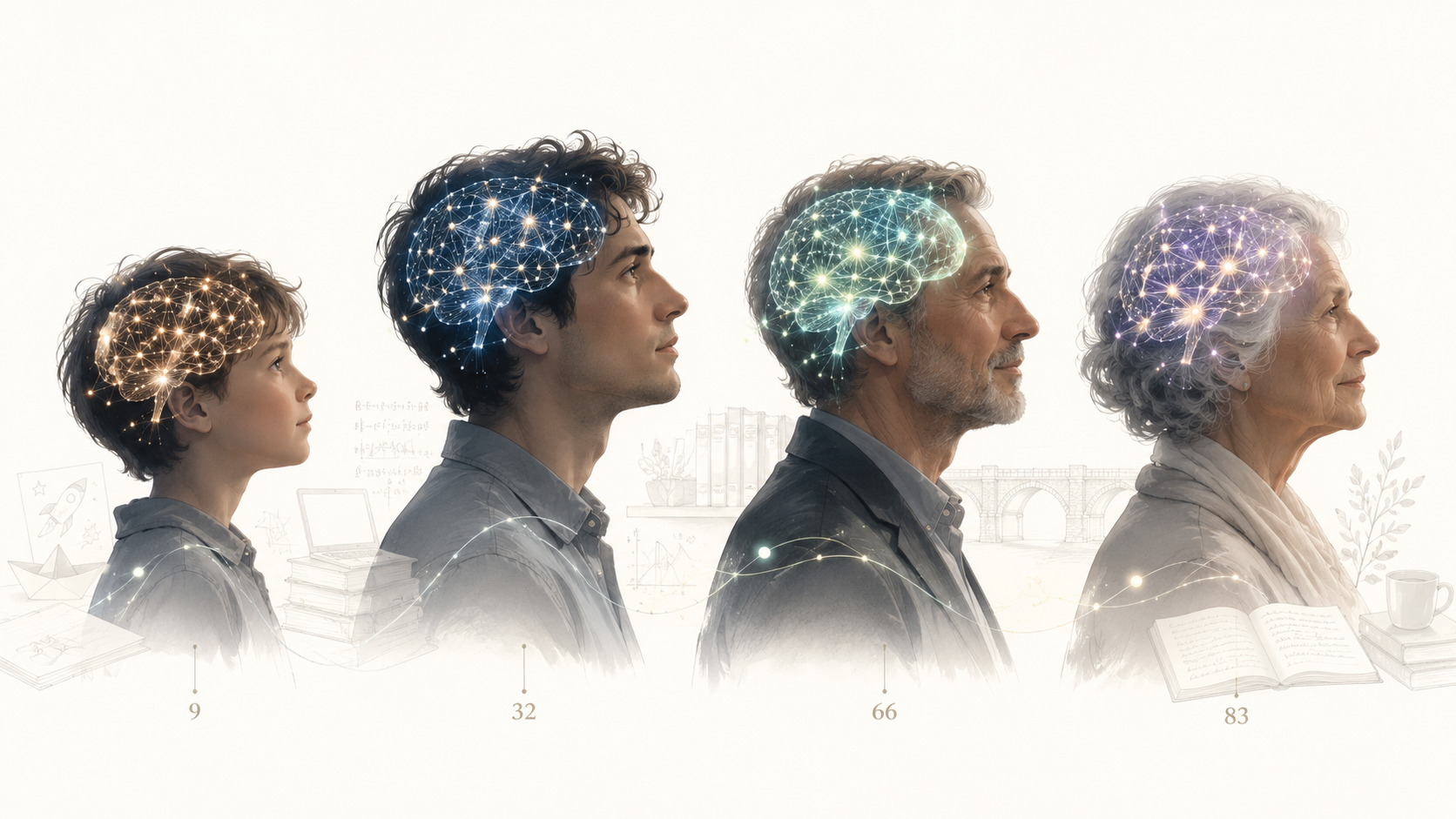

The brain continues to change throughout life; the key is how willing we remain to adapt.
At what age do we become adults?
Legally, it is eighteen. According to a common claim regarding brain development, perhaps twenty-five. Based on societal expectations, it might be thirty or forty. In the academic world, however, there is a much more detailed timeline: undergraduate student, graduate student, postdoctoral researcher, assistant professor, associate professor, professor…
Yet, the brain seems unconcerned with any of these categories.
A study by Mousley and colleagues examined diffusion MRI data from 4,216 individuals spanning ages from birth to 90 years. Rather than simply looking at the size of specific brain regions, the researchers analyzed how the brain’s structural connections are organized as a network. Four key milestone ages were identified in this organizational process: 9, 32, 66, and 83. The most distinct transition occurs not at age 18, but around age 32 (https://www.nature.com/articles/s41467-025-65974-8).
Between approximately ages 9 and 32, the brain’s structural network exhibits increasing integration and efficiency, alongside changes in specialization. Around age 32, some of these developmental trajectories shift direction. From that point until approximately age 66, the brain enters a relatively long period characterized by much more gradual changes in network architecture. Another shift is observed at age 66, while a distinctly different pattern emerges around age 83. This does not mean that we remain adolescents until our thirty-second birthday, or that something suddenly shifts in everyone’s brain at exactly age 32, 66, or 83. However, the study challenges our tendency to view human development as a journey that concludes somewhere in early adulthood.
Other research supports these findings as well. In 2025, Sun and colleagues aggregated functional MRI data from 33,250 individuals across 132 centers, spanning from before birth to age 80. They, too, found that the brain’s functional connections change in a non-linear fashion throughout life. Different networks follow distinct developmental timelines, with significant, broad inflection points evident well into the third and fourth decades of life (https://www.nature.com/articles/s41593-025-01907-4).
An even more extensive initiative, the “Brain Charts for the Human Lifespan” project, compiled 123,984 MRI scans from over 101,000 individuals, ranging from mid-gestation to age 100. It revealed that gray matter, white matter, and other brain characteristics follow strikingly different trajectories. No single moment could be identified when development could be definitively declared complete (https://www.nature.com/articles/s41586-022-04554-y).
The same holds true when we shift our focus from brain structure to cognitive abilities. Joshua Hartshorne and Laura Germine examined the cognitive performance of 48,537 individuals and found—surprisingly and challenging conventional wisdom—that those who assume intellectual peak occurs at a single age are wrong: different abilities peak at different ages. While some capacities reach their maximum in late adolescence, others do so in one’s twenties or thirties, and still others in one’s forties or beyond. At virtually any stage of adulthood, our performance on one cognitive task might decline while remaining stable on another and improving on a third (https://pubmed.ncbi.nlm.nih.gov/25770099/).
Consequently, there may be no such thing as being at an intellectual “peak.”
This could have implications that extend far beyond neuroscience.
We organize society as if age were a reliable indicator of developmental status. We grant legal adult status at age 18. We expect people to have established their professional and personal lives by around age 30. And we begin discussing retirement around age 65. These boundaries may be administratively functional, but biology is under no obligation to adhere to administrative conveniences.
The academic world can be particularly prone to conflating chronological age with capacity.
We use the term “early-career researchers,” assuming that intellectual development is concentrated at the start of a career. Funding programs impose limitations based on factors such as age or the time elapsed since earning a PhD. Academic CVs are quietly evaluated against an expected trajectory—a PhD at this age, independence at that age, a professorship at another. Someone who enters the world of research at the age of 45 is considered “late.” Yet, someone who produces their best work at 70 is treated almost as an exception.
However, the brain is not a mechanism subject to the academic tenure clock.
Aging does not simply signify a process of decline. Aging brains undoubtedly undergo structural and functional changes. On average, large-scale functional networks tend to become less segregated and less specialized with age. However, it is not merely a matter of loss; aging brains can engage networks in different ways, compensate for changes, and continue to respond to experience.
A compelling example of this comes from the realm of music.
In a randomized study involving 134 adults aged 64 to 76 who had never learned to play the piano, six months of piano training was associated with increased cortical thickness in the brain’s auditory regions compared with a control group that merely listened to music. The aging brain does not lose the capacity to respond—at a structural level—to a new and challenging skill (https://nyaspubs.onlinelibrary.wiley.com/doi/full/10.1111/nyas.14762).
Physical activity presents a similar picture. Research suggests that exercise can alter functional brain connectivity in older adults, demonstrating experience-driven structural and functional plasticity, particularly in regions critical for memory (https://www.sciencedirect.com/science/article/abs/pii/S0047637421000658).
This suggests that age has a complex impact.
Processing speed, accumulated knowledge, memory, reasoning ability, vocabulary, pattern recognition, and emotional regulation skills do not all change in unison. Brain volume, white matter integrity, and functional connectivity do not follow the same timeline. Biological aging itself varies greatly among individuals.
Perhaps our academic culture should reflect this complexity.
A 28-year-old researcher might bring speed, flexibility, and a willingness to abandon old assumptions. A 58-year-old researcher, meanwhile, might possess decades of accumulated patterns, contextual knowledge, and the ability to discern which questions are worth asking. Neither profile is inherently superior to the other. More importantly, neither is static.
This situation could also shift our mindset regarding mentorship.
We often imagine mentorship flowing top-down: senior academics training junior ones. But if human cognitive development follows a multifaceted, lifelong trajectory, perhaps mentorship should be multifaceted as well. Young researchers can transform the intellectual networks of their senior colleagues, just as senior researchers shape theirs. A laboratory, department, or university can be viewed not as a hierarchy of “finished” and “unfinished” minds, but as a network of minds at different points along diverse developmental trajectories.
A more personal takeaway can also be drawn from the research mentioned.
Academic life generates a unique kind of anxiety regarding time.
Too late to pursue a PhD.
Too late to switch fields.
Too late to learn statistics.
Too late to start writing.
Too late to return to research.
Too old to learn a new method.
Research does not support the fantasy that everything is equally easy at any age. Nevertheless, this provides a valid reason to view the phrase “too late” skeptically. The human brain does not simply remain static until it reaches a final form and subsequently begins to decline; it constantly restructures itself. Different abilities follow different developmental trajectories. Experience remains significant. Even in later life, the brain retains the capacity to undergo measurable changes.
It is a process of constant change.
The brain may enter a new topological phase at age 32; another around age 66, and perhaps yet another around age 83… These figures should not harden into new patterns that merely replace the old ones. Their true value lies in reminding us just how artificial the patterns we create actually are.
An academic career should not be a race toward “completion”; it should be a lifelong process in which we preserve our capacity to transform into someone different.