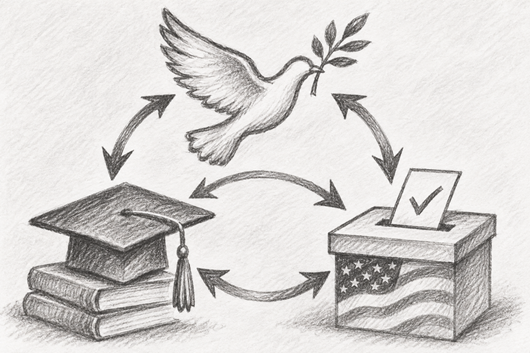


We must protect academic freedom not only against governments we oppose but also against those we support.
On November 3, 2026, American voters shifted the political balance in their country. By securing a majority in both chambers of Congress, the Democrats gained new opportunities to oversee federal policies that affect universities, scientific research, and international academic collaboration. For researchers concerned about political interference in science, these election results may offer a renewed sense of hope (https://www.ap.org/the-definitive-source/behind-the-news/calling-control-of-congress-in-the-2026-midterm-elections/).
However, elections raise a more fundamental question: Should our freedom to conduct research, teach, and express our scientific views depend on which political party wins an election?
The answer to this question must be “no.” Academic freedom is not a privilege granted to scholars by governments that happen to be sympathetic to science; it is an indispensable condition for the production of reliable scientific knowledge. If a university feels free under one administration but threatened under another, it suggests that the institutional safeguards protecting academic freedom are not sufficiently robust.
In recent years, the relationship between political power and scientific research has become increasingly visible in the United States. Disagreements regarding federal research funding, university governance, institutional autonomy, and international academic collaboration—particularly in 2025 and 2026—have demonstrated the extent to which political decisions can influence academic life.
The Trump administration proposed significant changes to federal scientific research funding and the oversight of such research. Proponents of increased federal oversight emphasized the principles of responsible use of public resources, transparency, and accountability. Critics, however, warned that funding restrictions and the prioritization of research areas based on political agendas could undermine scientific independence (https://www.nature.com/articles/d41586-026-01779-z).
It would be a mistake to view this debate merely as a budgetary dispute. Research funding determines which scientific questions can be explored, which projects can be sustained, and the conditions under which early-career researchers can develop their academic paths.
Accountability in the use of public resources is, of course, both legitimate and necessary. Universities that benefit from public funding should be subject to oversight regarding scientific quality, financial integrity, and social responsibility. However, accountability must not evolve into a mechanism through which political authorities dictate which scientific findings are deemed acceptable.
Perhaps the most concerning consequence of political interference is not the activities explicitly prohibited by the government, but rather the actions that academics, over time, choose to abandon of their own accord.
A survey published by Inside Higher Ed shortly before the U.S. midterm elections points to this very issue. Forty-four percent of the 1,665 faculty members who participated in the survey state that they feel less free to discuss federal politics than they did a year ago. Approximately half of the respondents indicate that they avoid making certain public statements, while 24% report steering clear of topics they would otherwise research or publish on under normal circumstances (https://www.insidehighered.com/news/faculty/academic-freedom/2026/11/02/faculty-report-self-censoring-dei-politics).
Academic freedom can erode even in the absence of formal censorship. Intellectual independence becomes increasingly fragile when researchers shy away from controversial questions, faculty members hesitate to address sensitive topics in their courses, or early-career scholars fear the professional repercussions of expressing their scholarly views.
Moreover, quantifying this damage is exceptionally difficult. While we can count research grants that have been rescinded or laboratories that have been shut down, how could we possibly determine the number of research projects never proposed, hypotheses never tested, or ideas never discussed?
The Democrats’ electoral victory could shift the balance of power in Washington, particularly through congressional oversight, budget negotiations, and new legislative measures. That said, Donald Trump remains in the presidency, and the new Congress will not take office until January 2027.
Therefore, it is premature to assume that the election results will automatically reverse existing policies or immediately restore the lost confidence of researchers.
Furthermore, we should not place the responsibility for safeguarding academic freedom solely on any one political party.
Different governments may prioritize various scientific fields, educational policies, or methods of accountability. These are legitimate subjects for democratic debate. However, a fundamental principle that must remain outside the realm of political bargaining is that scientific methods, research findings, and academic evaluations should not be determined by political allegiance.
To gauge the extent to which a government respects scientific freedom, we should not look at how much it supports research that aligns with its own priorities, but rather at the space it affords to scientific work that yields results it finds uncomfortable.
The United States is not the only country facing these challenges. In nations with vastly different political systems, universities can come under pressure—whether through the allocation of research funding, administrative appointments, restrictions on freedom of expression, or the imposition of ideological expectations.
UNESCO’s 1997 Recommendation concerning the Status of Higher-Education Teaching Personnel recognizes institutional autonomy as a key safeguard for academic freedom. The same document also emphasizes professional responsibility, public accountability, and the freedom to conduct scientific research and disseminate its findings (https://www.unesco.org/en/legal-affairs/recommendation-concerning-status-higher-education-teaching-personnel).
We need transparent and independent mechanisms for research funding, robust protections against arbitrary dismissal, meaningful participation by academics in university governance, and effective avenues for challenging political interference.
Yet, institutional safeguards alone are not enough. There is also a need for an academic culture rooted in intellectual tolerance. We must be able to defend the freedoms of academics—even those whose conclusions we disagree with, provided they adhere to scientific standards and professional ethical principles.
Otherwise, academic freedom ceases to be a shared, universal principle and instead becomes a selective demand, invoked only in specific circumstances.
Elections matter. They can alter budgets, laws, oversight mechanisms, and institutional priorities. In this sense, the 2026 U.S. midterm elections could present significant opportunities for the American academic community. Yet, elections alone cannot guarantee academic freedom.
A truly independent academic system must be capable of questioning political power, even when that power is held by a government supported by the majority of its own academics.