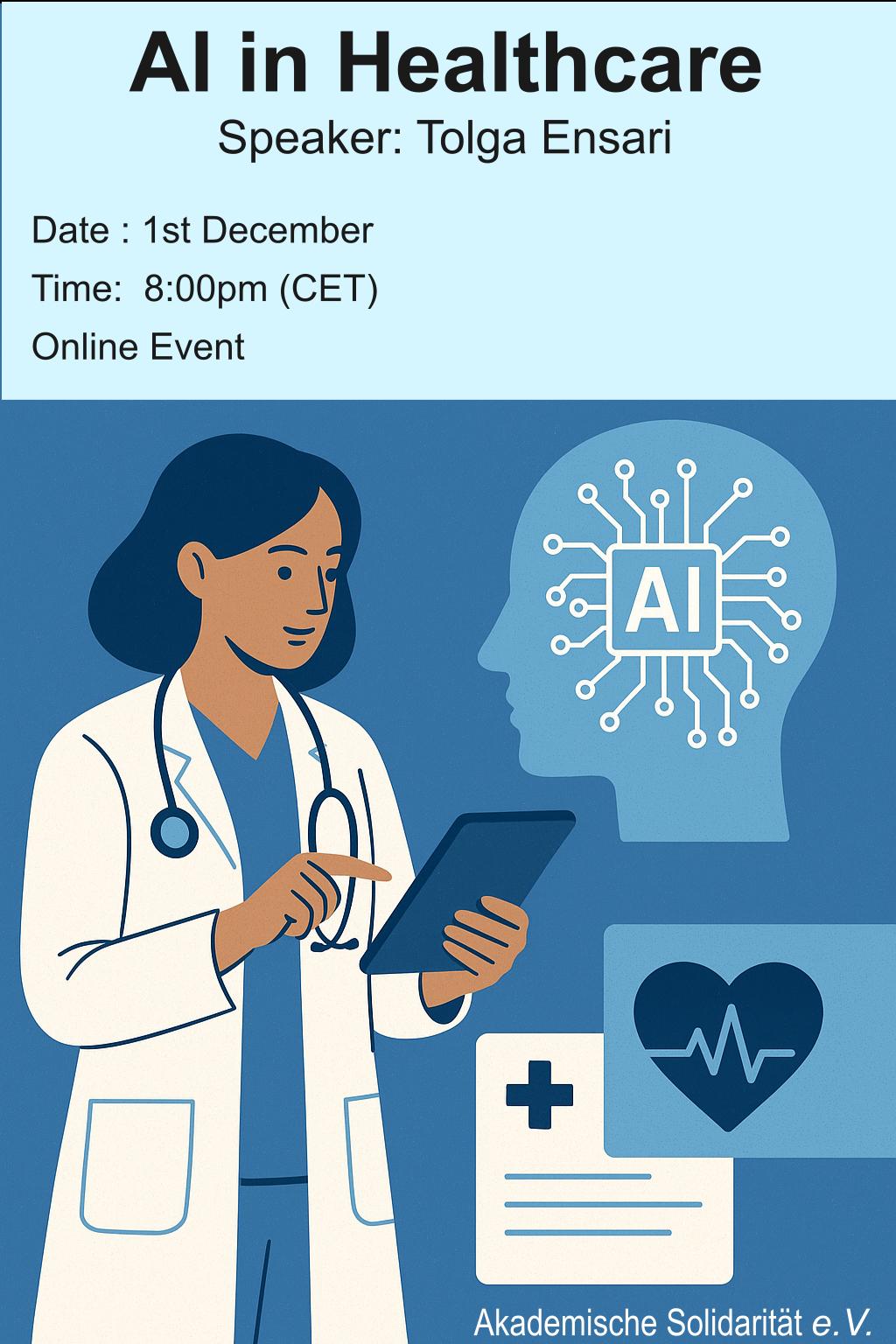

Approximately 90 people from various countries and healthcare disciplines attended the online seminar “AI in Healthcare,” organized by Akademische Solidarität e.V. on December 1, 2025. The seminar speaker was Dr. Tolga Ensari, a faculty member in the Department of Computer Science at Arkansas Tech University.
At the beginning of his speech, Dr. Ensari summarized the development of artificial intelligence and its fundamental mathematical and statistical infrastructure, emphasizing that AI is not just about programming; it possesses a broad knowledge base, ranging from differential equations and optimization to graph theory and probability models.
In the main part of the speech, Dr. Ensari discussed the current applications of artificial intelligence in healthcare:
- AI-assisted diagnostic systems in medical imaging (CT, MRI, pathology) have become widely used in areas ranging from cancer detection to image interpretation.
- Clinical decision support software (e.g., IBM Watson Health) is accelerating physicians’ diagnostic and treatment processes.
- The transformation of text, genome data, or sensor outputs into AI algorithms was explained with examples.
- Emerging areas included digital mental health, biological computers, the concept of next-generation “actual intelligence” working with nerve cells, and biologically inspired models such as spiking neural networks.
Dr. Ensari also explained with concrete examples that artificial intelligence, like humans, can “make mistakes.” Tesla cars in Australia failing to recognize kangaroos and stopping, or image classifiers confusing the difference between a muffin and a puppy, were shared as examples demonstrating that AI systems should not be considered absolute accuracy.
The seminar covered ethical principles and upcoming legal regulations extensively. Within this framework, data privacy, fairness and transparency, human control, manageability, and traceability were defined as fundamental conditions for AI systems.
The seminar also shared examples from the comprehensive “technology constitution” studies that have been underway in the US and EU for five years. The legal liability of physicians when using AI, shared responsibility in potential malpractice lawsuits, and the direction of future regulations were discussed. Dr. Ensari also answered the questions of the participants:
- It is now common for patients to consult tools like ChatGPT before seeing a doctor; however, it may be ethically more appropriate for the doctor to conduct the conversation with the AI in front of the patient and in a transparent manner.
- It was emphasized that if the AI makes an incorrect decision, the software cannot be held solely responsible.
- It was stated that AI systems capable of meta-analysis are becoming increasingly powerful and could soon completely transform scientific research processes.
- It was stated that the use of AI for casual conversations on mental health-related topics is harmful, but licensed “Digital Mental Health” systems could be beneficial.
At the end of the seminar, one participant discussed the practical benefits of AI-powered software like Tandem Health, used in primary care in Sweden:
- Automatically transcribing physician-patient conversations and converting them into medical notes,
- Creating correspondence such as reports, referrals, and sick leave documents in seconds,
- Automating drug interactions and guideline checks.
Another participant discussed Heidi Health, a transcription and decision-support tool used in Germany, emphasizing the importance of integrating this software into local systems, particularly due to data security requirements.
“Time to Get Out of Your Comfort Zone”
At the end of the program, when one of the moderators remarked that the seminar had “pushed him out of his comfort zone and into a fear-learning-development cycle,” Dr. Ensari responded with the following words:
“Being afraid is good. Because it’s the beginning of learning and development.”
This comprehensive seminar, organized by Akademische Solidarität e.V., demonstrated how AI is transforming healthcare, from technical, ethical, and practical perspectives. The intense interest and active contributions of the participants demonstrated once again that healthcare professionals are ready for this change, but that the road is still very early.