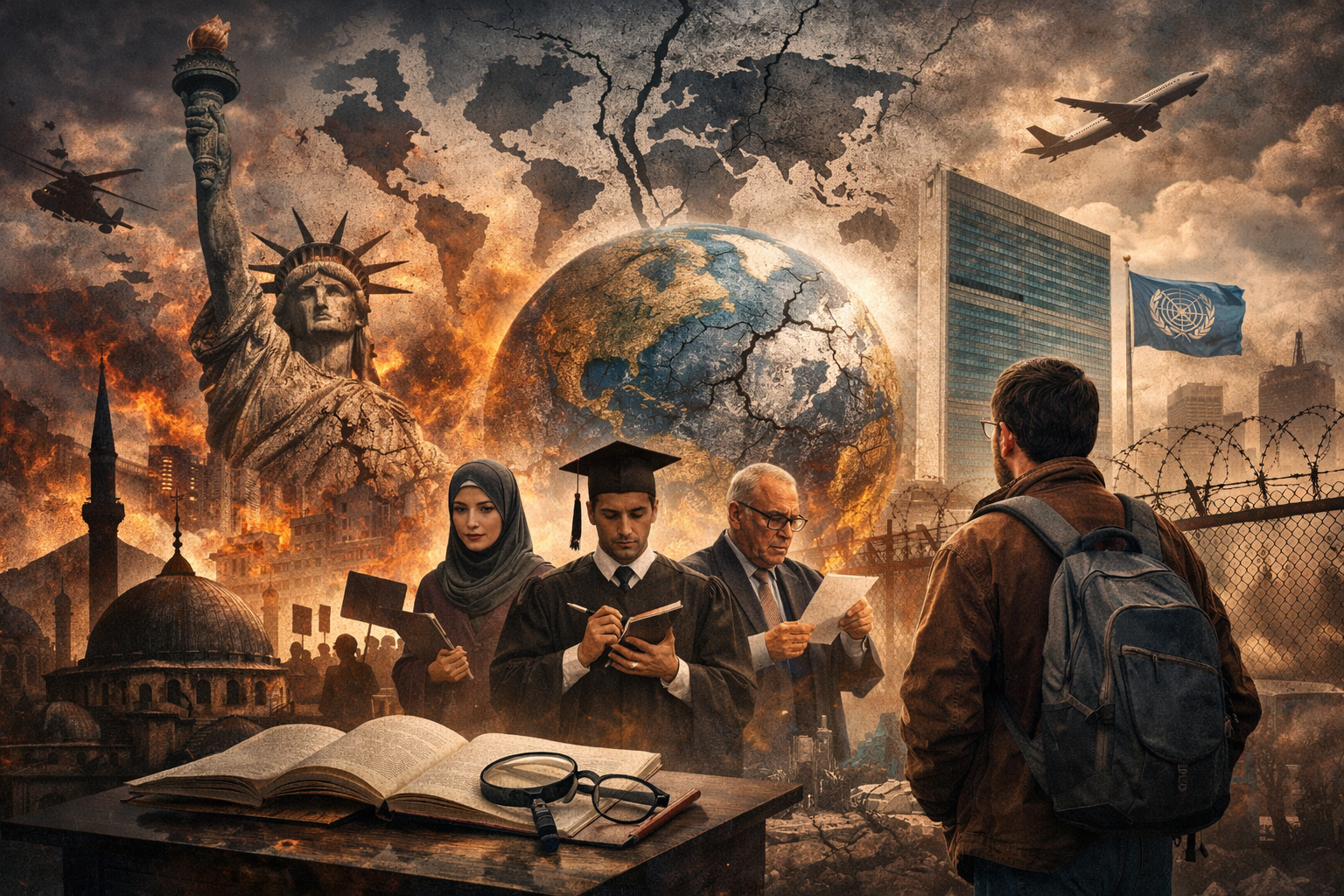

In a period when trust in international institutions and dominant ideologies is shaken, the search for “meaning” is not only an individual problem; it also shapes the future of academic production, freedom of expression, and public debate.
An analysis published on TR724 argues that the cultural and political influence of American hegemony is weakening, the current global order is losing its ideological persuasive power, and this is being replaced by a search for new, as yet undefined, norms. This discussion particularly highlights the perception of double standards that hinder the assimilation of universal values such as justice, equality, and freedom. It is stated that the American-centric, uniform definition of culture and success will be replaced by a globalized multiplicity of voices, but this has not yet been clearly defined in a model (https://www.tr724.com/amerikan-ruyasinin-ardindan-islami-dusuncenin-yeni-kuresel-duzendeki-yeri/).
At one end of this search for global norms lies the possibility of a global re-discussion of Islamic thought. As the established Western-centric narrative weakens, alternative cultural and faith-based frameworks can offer avenues for meaning-making. However, when such a discourse goes beyond mere discussion of cultural preferences (i.e., when it enters the realm of public and educational policies and freedom of thought), the necessity arises to evaluate it within the context of academic freedom.
No matter how widely ideological ruptures and searches for meaning are discussed globally, they can only be addressed in a free and pluralistic research environment. Academic freedom is a fundamental prerequisite for the sustainability of a society’s intellectual capacity and public reason. However, today there are strong indications that this freedom is being restricted in many countries (especially Turkey).
In Turkey, academic freedom has systematically declined since 2016. The country ranks low in various academic freedom indices, and university autonomy has been significantly weakened. This structural change leaves research, publishing, and teaching activities under sharply repressive conditions. Academics face the risk of investigation, disciplinary action, or dismissal when expressing their political views (https://www.researchgate.net/publication/365383126_Academic_Freedom_in_Turkey).
The “Call for Peace” (We Will Not Be Complicit in This Crime!) declaration, published in 2016, signed by thousands of academics, is one of the best-known examples in Turkey. The signatory academics faced heavy public and media pressure; some were arrested, and hundreds were dismissed or forced to resign. This process demonstrated how fragile academic freedom is when those representing academic thought in the public sphere directly clash with state policies (https://en.wikipedia.org/wiki/Academics_for_Peace).
This example also underscores the importance of international academic solidarity in response to global calls. Academics in the diaspora, while defending rights-based norms, draw attention to the repressive environment in their own countries, attempting to position the issue as a matter of freedom in the global public sphere. Such transnational networks are not merely individual advocacy practices, but can also contribute to the redefinition of universal norms of academic freedom (https://www.academia.edu/143876743/Peace_Profile_Academics_for_Peace_in_Turkey).
According to the TR724 commentary, the erosion of hegemonic narratives in the current world order makes it possible for different intellectual traditions to become visible again. In this context, Islamic thought is positioned on the horizon of discussion as an alternative, especially when Western-centric norms are criticized.
However, the critical question is: In what environment and within what frameworks are we discussing the search for global norms? Unless comparative analysis of intellectual traditions and issues such as faith and secularism is addressed at the academic level, such discussions can turn into polarizing discourses and popular manipulation in the public sphere. Therefore, academic freedom and an independent research environment represent not merely a normative choice such as “which thought is better?”, but a ground where ideas can be discussed fairly, evidence-based, and critically.
Today, many academics have been forced to leave their countries due to political pressure, human rights violations, or economic hardship. These intellectuals, in exile, strive to continue their work in their respective disciplines while also bringing new perspectives to global academic communities.
The experiences of exiled academics are not merely stories of individual victimization. They also constitute crucial focal points for rethinking global academic networks, normative values, and freedom of expression. These intellectuals, operating across diverse cultural and legal contexts, can contribute to global knowledge production and thereby mediate the expansion of academic freedom beyond the national level.
It is not surprising that people and societies embark on a “search for meaning” amidst the fragility of the global order. However, for this search to be conducted fairly, pluralistically, and freely, it cannot be reduced to a mere clash of values, as it might suggest; free academic production, freedom of expression, and a public sphere of debate are indispensable.
In countries like Turkey today, where academic freedom is restricted, intellectuals are under pressure or forced into exile. Discussing the global search for meaning necessitates defending the spaces that will guide this discussion.